Posts Tagged ‘Indian classical music’

Kala Ramnath Full Concert (April 23rd, 2006 - Utrecht, The Netherlands) - Enjoy!

Tuesday, March 12th, 2013

On 23 April 2006 I filmed Kala Ramnath’s concert at RASA in Utrecht/The Netherlands. Since then I published a lot of this concert in separate parts. Finally I’ve now uploaded the complete concert on my YouTubechannel.


Kala Ramnath/violin; Satyajit Talwalkar/tabla; Celine Wadier/tanpura

00:00 - 57:48 Raag Madhuvanti
58:13 - 1:27:40 Raag Dinki Puriya
1:27:54 - 1:39:45 Composition in Raag Des

It’s great to be able now to play this fabulous concert in one go! (Yes, fans/admirers of Kala, you should really thank me for this upload :) ) And for the first time you can now enjoy Kala’s complete Madhuvanti in this concert, which is a great bonus!

HOME

“Once you’re all done with writing, can we play this section?” - Notities bij een ragaklasje

Sunday, March 10th, 2013

Bovenstaande video toont een ragaworkshop in New York, verzorgd door topvioliste Kala Ramnath. Westers klassiek geschoolde muzikanten brengt zij wat beginselen bij van de alap, de openingssectie van een ragaperformance. De workshopdeelnemers dienen door haar gespeelde frasen op het gehoor na te spelen. Wat de muzikanten te doen staat is duidelijk: goed luisteren en dan op je instrument imiteren wat je hebt gehoord.

Niet wat we horen, maar vooral wat we zien vind ik opmerkelijk. De muziekstandaard, het attribuut voor de neus van de deelnemers, wordt nadrukkelijk in het proces van luisteren en spelen betrokken. Stilzwijgend dirigeert de lessenaar het klasje telkens naar het papier, naar lege notenbalken die uitnodigen tot noteren-vastleggen-lezen wat men hoort. Voor de workshopdeelnemers is de muziekstandaard een zwijgzame bondgenoot die een interventie mogelijk maakt tussen wat ze te horen krijgen en wat ze vervolgens gaan spelen.

De muzikanten pogen steeds te noteren wat ze horen, zoals zij dat blijkbaar gewend zijn in een muzikaal leerproces. Deze schriftgerichte benadering ‘wringt’ met de voornamelijk op orale overdracht gerichte methodiek binnen Kala Ramnath’s Indiase ragatraditie.

Dit ragaklasje vertoont een zekere fixatie op notatie en klampt zich zo vast aan vertrouwde mores en (Westerse) methodieken. Is dat verkeerd of een probleem? Nee hoor, helemaal niet, maar - zoals gezegd - er wringt wel iets: een zo sterke drang tot noteren en lezen valt niet alleen op, maar doet in een ragasetting nogal wezensvreemd aan. Tegelijkertijd levert het natuurlijk ook wel weer een boeiend kijkspel op.

HOME

Anoushka’s great blend of Hindustani & Flamenco

Tuesday, March 5th, 2013


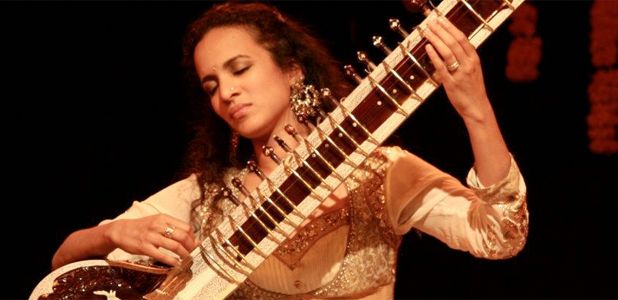
Despite the fact that flamenco, the fiery song and dance genre from Andalusia/Spain, is a well known genre all over the world, it’s still not common knowledge that the genre’s ancient roots lie in gypsy music from Rajashtan/India. A great and awarded album exploring this India-flamenco connection is Traveller by renowned sitar player Anoushka Shankar. On this album - I quote from her website - “she finds her way into the nuances of modern flamenco through the vivid lens of Hindustani technique. In essence, Traveller charts the spiritual link across time and space of two highly evolved forms of musical expression, from their ancient gestation to their modern zenith.” On her homepage Anoushka Shankar adds: “I’ve always loved flamenco and had a fascination for it. There’s always been that pull towards something I find very similar in flamenco to what I cherish in Indian classical music: a kind of uninhibited musicality in expression, whether it’s a solo voice, a sitar or a guitar. Of course there were common roots and technical similarities to explore, and when you start to play with those, you can really delve down in very delicious ways. However the desire came from simply being an admirer of the music, and wanting to learn about it through making music.”
The album release in 2011 was followed by a world tour, and from this tour the inspiring and well recorded concert below is a joy for watching and listening. So, without further ado, enjoy the great musicianship and temperament of Anoushka Shankar and her fellow travellers on stage!


Anoushka Shankar’s Traveller concert at Festival Les Nuits de Fourviere (Lyon/France), July 13th, 2012

HOME

Pakhawaj playing at its best by the young and brilliant Mahima Upadhyay

Sunday, February 10th, 2013

What an amazing young talent, evry detail soo beautifully articulated. Listening to the rich sound of this rhythm queen is truly a listener’s delight. I think the Gundecha Brothers, on front row in the audience, will agree with me.

HOME

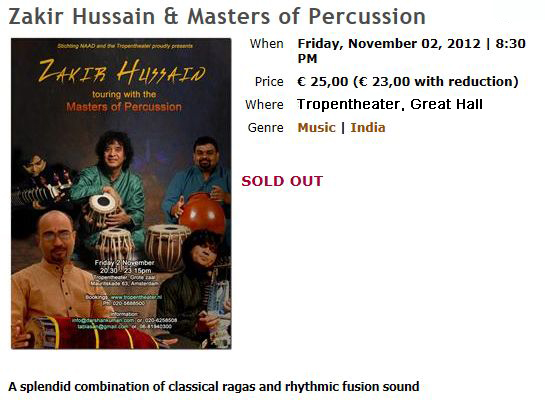
2 Nov.’12 Amsterdam Tropentheater concert tabla legend Zakir Hussain sold out in a beat

Tuesday, October 30th, 2012


On Friday 2 November 2012 legendary world famous tabla player Zakir Hussain will play with his Masters of Percussion group in the Great Hall of Amsterdam’s Tropentheater. Zakir Hussain will be joined on stage by young brilliant sitar player Niladri Kumar and other great musicians on a variety of instruments including the dholak, ghatam, tabla, kanjira, bansuri and sarangi. For evryone going to the concert it will be a sheer delight to witness the tabla genius playing again in The Netherlands. It will be the third time that I’ll visit a concert of him in Amsterdam. Last time was in 2008 when Zakir Hussain performed with The Masters of Percussion at the Amsterdam India Festival and somewhere in the early nineties (or was it even earlier?) I saw the king of Indian beats performing live on stage in Amsterdam with sarangi player Ustad Sultan Khan. All were memorable great events, due to Zakir’s charisma and overwhelming musical powers. There’s so much said and written about him in books, newspapers, articles and all over the web… what can I add here? Let me just add a quite recent (and quite funny) two-part video-interview with him - shown below - and maybe this one good advise: always book early when Zakir Hussain is playing in your neighbourhood! The concert in Amsterdam I’m going to on 2 November was sold out in a beat. I’m glad I won’t miss one beat of it coming Friday! :)


HOME

Amelia Cuni’s beautiful interpretation of John Cage’s ‘Solo for Voice 58: 18 Microtonal Ragas’

Tuesday, October 30th, 2012

Early September 2012 I heard (and met) Italian dhrupad singer Amelia Cuni in Göttingen, where she did a concert titled Cosmopolit@n Ragas. It was a beautiful musical event in two parts, starting out with Amelia Cuni’s performance of a raga in traditional dhrupad style. Then she took things in another direction by presenting her dhrupad-styled improvisational skills in a very different musical framework: she performed John Cage’s Solo for Voice 58: 18 Microtonal Ragas. Here I like to share a beautiful recording of Amelia Cuni interpreting this work of John Cage. Enjoy!

HOME

Wonderful concept for an enhanced experience of raga music: The Silence Concert

Sunday, September 30th, 2012

To help people experience the power of Indian classical music, married and musical couple cellist Saskia Rao de Haas and sitarist Shubhendra Rao started the Silence Concert movement, to experience music in its purest form: surrounded by silence. An intriguing, fascinating concept.

Saskia and Shubhendra explained their initiative in The Hindu of 19 September 2012 and here’s what they have to say about it on the Silence Concert Facebook-page they created:

“What is a Silence Concert?
For the sensitive listener, there can be a big difference in attending a concert and experiencing music. The effect that music can have on our lives, especially Indian music, is often lost by the social conventions that prevail at concerts: applause, talking before and after the concert, ceremonies, all of which take the attention away from the music itself. To help people experience the magical power of Indian music in a concert setting, Pt Shubhendra Rao and Saskia Rao initiated the Silence Concerts movement. In a Silence Concert the only sound that reverberates is music. There are no introductions, ceremonies, gimmicks, talks, speeches or applause. The setting is serene, beautiful and set up to experience beauty within through the pure experience of music. Through controlling external influences that can distract listener and performer the experience of pure music is enhanced.
Entering the auditorium for a Silence concert, the audience and artists leave behind their worries and daily masks, because they do not have to respond in word or gesture to the outside world. They can be gently led through a sublime journey within. What follows is that their experience turns within. The artist can share his music without playing to the gallery and the effect lingers after the concert, not interrupted by applause.
Abhinavagupta (approx. 950-1020 AD), the Indian philosopher, said that the ‘perfect audience is a spotless mirror of the performer’. Audience and performer become one in a Silence concert. The social context is taken out and the audience is left with a truly introspective experience, as is the performer.”
(Saskia Rao de Haas and Shubhendra Rao)

Saskia and Shubhendra end with a quote of Sufi Inayat Khan (1882-1927):
“While tuning the tanpura, the artist tunes his own soul. Not only has he tuned the instrument, but he has felt the need of every soul in the audience and the demands of their souls, what they want at that time. He becomes an instrument of the whole cosmic system, open to all inspiration at one with the audience, in tune with the tanpura and it is not only music, but spiritual phenomena that he gives to the people…‘ The object of Indian music is the training of the mind and the soul, for music is the best way of concentration. If one only knows how to appreciate it and give one’s mind to it, keeping all other things away, one naturally develops the power of concentration. Besides the beauty of music, there is the tenderness, which brings life [and gratitude] to the heart. For the person of fine feelings life in this world is very trying. It is jarring and it sometimes has a freezing effect. It makes the heart, so to speak, frozen. If one can focus one’s heart on music, it is just like warming up something that was frozen. The joy of life depends upon the perfect tuning of mind and body.”

HOME

Raga Unveiled - ambitious cinematic effort to grasp the essence of Hindustani classical music

Thursday, December 29th, 2011

I reported earlier on ‘Raga Unveiled’, an ambitious cinematic effort to take a look at the history and essence of the Hindustani classical music system. In this film - directed by Gita Desai and released in 2009 - scholars and great artists of today unveil the raga and demonstrate evrything you always would have liked to know about Indian classical music.
Here’s the trailer:

For anyone interested in raga music this 260 minute-film is a ‘must’ and of course it’s needless to say that you should see and buy the film on dvd in much better quality.

HOME

From the Hoboken Collection : Arnold Bake’s radiotalk (script) on Rabindranath Tagore

Saturday, May 7th, 2011


It’s certainly been too long - but better late, than never - since I announced to write on some of the interesting documents I found three years ago at Radio Netherlands from the legacy of Peter van Hoboken (1901-1994), Head of Transcription Service at Radio Netherlands from 1948 to 1966 and one of the great pioneers and promotors of Indian classical music in the Netherlands*. For several decades already there has been another and bigger Van Hoboken-collection that is incorporated in the Felix van Lamsweerde-collection, but most of the material that I came across at Radio Netherlands is different and therefore an interesting addition to the material that was known already.

Peter van Hoboken
Peter van Hoboken in his office at Radio Netherlands

From here I’d like to refer to these documents as the Radio Netherlands Hoboken Collection, abbreviated as RNHC. My find in January 2002 of a unique recording by Radio Netherlands in 1957 of sitarist Ravi Shankar already illustrated the great value of Peter van Hoboken, who organised this recording. As an adept of Indian classical music and dance Van Hoboken organised recordings of concerts in The Netherlands and he produced many Radio Netherlands programmes on Indian classical music.


At this point I want to proceed with some interesting documents I found among the RNHC, concerning radiotalks done in 1950 by world famous dutch ethnomusicologist Arnold Bake (1899-1963), radiotalks Bake did in english and hindi about the musical life and culture of India, recorded for the Radio Netherlands Transcription Service to be distributed to presumably India and Surinam for broadcasts by stations over there. What I found of these radiotalks is only paperwork, Bake’s typed scripts along with his handwritten corrections. Unfortunately, the recorded tapes can’t be found in the Radio Netherlands Audio Archives, as these were sent to stations outside Holland, the main task of the Transcription Service.


Arnold Bake

It’s a great pity the recordings of Bake can’t be found in the archives of Radio Netherlands. I’ve asked Felix van Lamsweerde and they’re not in his Van Hoboken Collection. I would assume that they could have been stored in the Arnold Bake Archives, kept at the University of Leiden, but Felix and another expert, Fred Gales, told me that the collection over there contains only papers of radiotalks and not recordings. So, if not in Hilversum and not in Leiden, where can they be? Did the Radio Netherlands Transcription Service sent them to All India Radio and/or to Surinam or are they kept somewhere at the University of London’s School of Oriental & African Studies where Bake lectured? At this point I can’t believe they’re lost. I hope they can be found somewhere, as I’d like to hear how the scripts I found in Hilversum come alive in a radio transmission with Bake’s voice and with the music he talks about.


Rabindranath Tagore

The radiotalk-script I like to present here contains Bake’s thougths on India’s world famous writer, poet, philosopher and Nobelprize winner Rabindranath Tagore (1861 - 1941), in particular on ‘Tagore and his music’ and when I publish this it’s 7 May 2011, precisely the 150th birthday of Tagore. So, yes, this update on the RNHC took me too long, but I think I’m right on time with presenting these particular papers. :)


scriptpage 1, click a few times on the photo to enlarge


scriptpage 2, click a few times on the photo to enlarge


scriptpage 3, click a few times on the photo to enlarge


scriptpage 4, click a few times on the photo to enlarge

Let me add that I consider my short writings here on the RNHC as a work in progress. I don’t wanna pretend that I know all the details or have all the answers. That would be stupid and a false claim. If someone sees mistakes or things I overlook or has interesting additional information, please let me know.

* Radio Netherlands and Peter van Hoboken’s son Alexander have given me permission to publish these documents and write about them.

HOME

7 April 2011: Happy Birthday, Ravi Shankar !

Thursday, April 7th, 2011

Oceanic - Part 1, a beautiful, atmospheric track of Anoushka playing a sitar-duet with her father. Really touching. When I publish this message, it’s 7 April 2011, Ravi Shankar’s 91st birthday. Happy Birthday, Pandit ! :)

HOME