My experiment concerned with adjusting the ‘domestic version’ of F.W. Murnau’s cinematic masterpiece Faust to Timothy Brock’s Faust-score – composed for the ‘export version – has reached its completion. The result of my effort can now be watched in one go on my YouTubechannel or here embedded below. Watch the spectacular result of an incredible amount of editing from my part and see how I’ve found a way to combine the ‘domestic cut’ of Murnau’s Faust with Timothy Brock’s brilliant score for another cut of Murnau’s Faust, the so-called ‘export version’, which is almost 10 MINUTES LONGER(!) than the original domestic cut. Do you recognise the challenge here? I succeeded in fitting Brock’s 115min export version score to the 106min domestic cut, by endlessly manipulating the duration of sequences in the domestic cut to get it sync with Brock’s score. As a consequence the adapted domestic cut became of course also 115 minutes! Imagine the job I had to do here, I had to edit in such a manner that the film should keep its natural pace and feel, while all the time I had to manipulate its speed. Sometimes sound and image were half a minute out of sync! Also, beyond the manipulation of speed/duration of sequences, the film is presented entirely in its original order. If one keeps that in mind I think the result of my effort is quite spectacular.
An adjusted domestic Faust with Timothy Brock’s score, my edit.
The Faust-cut for which Timothy Brock wrote his score, the ‘export version’.
Take it easy, relax and take your time, for instance to enjoy “Organ²/ASLSP(As SLow aS Possible)”, the slowest and longest piece ever, by the late John Cage. The performance started in 2001, but if you only join in now, don’t worry, you haven’t missed much. How come? Well, performing the piece will only take 639 years, it’s nowhere near of a start yet, you’ve just missed 10 years at most. The playing, done by a Church Organ in Halberstadt-Germany, joyfully started on September 5th, 2001 and – if it doesn’t get too tired of this – is scheduled to end in the year 2640. Click here to hear the current sound!
The piece’s 11th Klangwechsel on August 5th, 2011
From a different angle once more the 11th Klangwechsel, in a 4’33” length video 🙂
The board chairman of the John Cage Organ Foundation in Halberstadt and involved in this project, Rainer Neugebauer, says that the performance is a rebuke of hectic modern life: “Everything does not need to happen so fast. If something needs a bit longer then it can give us an inner calm that is rare in normal life.”
Oh yes, that makes sense, but I also think ‘our normal lives’ could do with ‘a bit longer’, as they run out of time so fast. 🙂
Wow, fabulous… veery impressive! The awesome organ playing here works perfect as an addition to the events in Murnau’s classic ‘Nosferatu’. Hats off to Mathias Rehfeldt’s brilliant achievement! A must-watch!
I’ve finished a very interesting experiment concerning the cinematic masterpiece Faust by German director Friedrich Wilhelm Murnau. In eight videos on my YouTubechannel, all embedded below here in this post, the so-called ‘domestic version’ of the film is shown in a slightly different way than usual. For a good reason. The videos show the result of an incredible amount of editing from my part, the result of an experiment to find a way to combine the ‘domestic cut’ of Murnau’s Faust with a brilliant score, written by Timothy Brock for another version of this film, the so-called ‘export version’.
The Faust-cut for which Timothy Brock wrote his score, the ‘export version’.
———————————————————————————————————–
Now, let me show you what I’ve done and explain a little bit further how and why I did this.
An adjusted domestic Faust with Timothy Brock’s score, my edit, Part 1
F.W. Murnau’s masterpiece-film Faust was released in 1926 and there are seven known versions of the film. The most well known version is the so-called ‘export version’ with english titles, that premiered in december 1926 in the USA. The duration of the export-version is 115 minutes and 30 seconds, while the newly discovered ‘domestic version’ a couple of years ago lasts 106 minutes, the domestic version being the original ‘German print’, the one with German titles that was shown at the time in German cinema theatres.
An adjusted domestic Faust with Timothy Brock’s score, my edit, Part 2
The export print is darker and softer, lacking the detail and clarity of the domestic version. Incidentally, the differences between the export and the domestic version are considerable. There’s no difference in terms of the overall structure of scenes and storyline, but the pacing and lengths of scenes often vary greatly and there are often striking differences in the order and in the composition of shots, the domestic version certainly being the superior of the two.
An adjusted domestic Faust with Timothy Brock’s score, my edit, Part 3
Timothy Brock’s orchestral score, written for the Faust-export version is a masterpiece, a fantastic accomplishment, perfectly keeping with the operatic and epic nature of the film. The way Brock uses operatic- and leitmotif-storytelling and storydeveloping techniques in his music for the export version of the film is absolutely stunning. But, as soon as Brock’s score is played with the domestic version, picture and sound are almost evrywhere out of sync, that is, numerous details and leitmotifs of the score then miss the point, lose their ‘iconic’ meaning and strength and simply can’t work as they do so perfectly in the export version.
An adjusted domestic Faust with Timothy Brock’s score, my edit, Part 4
Isn’t it possible then to combine Brock’s music with the greatly cut and very clear print of the domestic version? The answer is ‘no’ when you play the music along with the domestic film in its original speed. The answer is ‘yes’ (that is, in my opinion) if you manage to adjust the speed of numerous sequences of the domestic film. Only when countless sequences are ‘manipulated’ in terms of duration the music is able to work once more on the pictures (and vice versa) as it does in the export version.
An adjusted domestic Faust with Timothy Brock’s score, my edit, Part 5
Now, I took it as a challenge to try to make Brock’s music work as well in the domestic cut version of Faust and with this aim in mind I’ve edited the complete domestic Faust.* I think the result of my editing is quite interesting and after the changes I made in the duration of countless sequences – a time consuming job that requires precision and a lot of patience – I personally think this brilliant music now also works very well for the complete domestic version.
An adjusted domestic Faust with Timothy Brock’s score, my edit, Part 6
For me the result has been quite spectacular. I’ve tried to keep the duration manipulation of sequences within reasonable measures, in order to maintain as much as possible the natural look, tempo and feel of the domestic Faust version.
**
An adjusted domestic Faust with Timothy Brock’s score, my edit, Part 7
I use all of Brock’s score and all of Murnau’s film, there’s no material left out by me. Enough said, hope you’ll find this ‘experiment’ as fascinating as I do and I hope you’ll enjoy these videos.
An adjusted domestic Faust with Timothy Brock’s score, my edit, Part 8
* If one might argue there’s already published a 2dvd set of Murnau’s Faust that plays both the export version and the domestic version with Timothy Brock’s score, I’d like to remind one then once more that Brock wrote his score (in 1995) for the ‘export version’, a perfect fit. If, however, the (later discovered) domestic version is played with Brock’s score on that dvd edition – an excellent release btw, the best you can get of Murnau’s Faust – evrything is totally ‘out of sync’ almost all the time, from seconds to even halve minutes. So, the option given with that dvd-edition to play Brock’s score with the domestic version was useless, didn’t pay off in any way. Seeing the wrong outcome of Brock’s score with the domestic version on that dvd-edition made me wonder and think about an alternative and that’s how I must have come up with the idea for an experiment, the result of which can be seen in the eight edited domestic Faust-videos in this post.
** An important question to be asked and probably raised immediately by film experts and critics: does the film still look like Murnau’s Faust after my experiment? A valid question of course. Personally I think it still looks like Murnau’s film in evry way, despite the fact that I affected the original ‘domestic version’ by manipulating the duration of shots and scenes. Anyhow, my ‘adjusting’ method was inevitable to make Brock’s score work for the domestic cut.
On tuesday 23 November 2010 at 23.05 PM German public radiostation WDR3 portrays phenomenal 30-year old (and my favourite) ragasinger Kaushiki Desikan Chakrabarty from Calcutta.
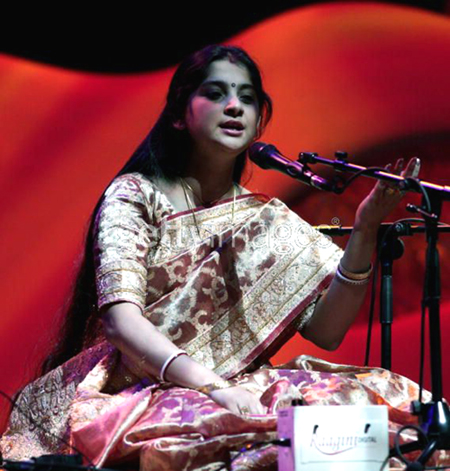
Kaushiki in 2010
Earlier, on 10 November 2010 WDR3 devoted a radio evening on Kaushiki, with a live broadcast of her concert in Bielefeld, a very beautiful performance that was described by renowned ragaspecialist Jan Reichow as “Das außergewöhnlichste, ergreifendste, intelligenteste, fröhlichste, innovativste Konzert Europas”. He’s not exaggerating. Kaushiki has it all and when you hear her live on stage her voice is able to touch your heart and soul deeper than you ever could have imagined… I’m saying this with great conviction as I’m speaking from my own wonderful experiences with hearing Kaushiki live in concert (at the Darbar Festival in 2008 in Leicester, and in 2007 in the Tropentheater in Amsterdam).
Kaushik performing in London in 2005, after she received the BBC3 World Music Award
WDR3 radio provides the following information for the radiobroadcast on 23 November 2010: Kaushiki Desikan Chakraborty gehört zu den großen Talenten der jungen Generation. Im Gegensatz zu früher dürfen Nachwuchskünstler heute schon viel früher ihr Können öffentlich zeigen. Kaushiki ist erst 30 Jahre alt und schon eine anerkannte Sängerin auf den großen Bühnen Indiens. Sie hat eine betörende Stimme und ein für ihr Alter ungewöhnliches technisches Vermögen. Die Pflege der alten Tradition ist ihr erklärtes Ziel. In diesem Sinne ist sie, obwohl jung, eine wertkonservative Künstlerin – mehr noch: sie trägt mit ihrer Haltung zum Überleben des klassischen indischen Geangs bei. Anlässlich ihres Bielefelder WDR-3-Konzerts vor knapp zwei Wochen erzählte Kaushiki unserer Autorin Clair Lüdenbach von ihrer Kunst und aus ihrem Leben.
Kaushiki sings ‘Yaad Piya Ki Aaye’ in Amsterdam, 2007
I like the way WDR Radio has tried to put in words the qualities of Kaushiki: “Die Sängerin Kaushiki aus Kolkata hat eine phänomenale Stimme und die stupende Fähigkeit, jede Nuance der großen traditionellen Form- und Melodiemodelle perfekt umzusetzen, von expressiven Wendungen, die ins herz treffen, bis zu Läufen und Koloraturen, die mit atemberaubender Geschwindigkeit ablaufen.” A very true, good description.
One of my very favourite clips on YouTube… Murnau’s cinematic masterpiece ‘Faust’ couldn’t be highlighted better than through this wonderful combination of sound and image…
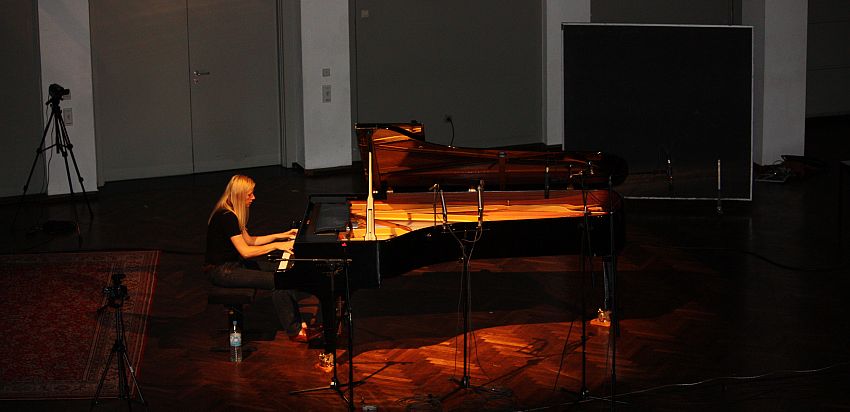
On August 17th, 18th and 19th 2010 I attended in the Beethovensaal in Hannover Valentina Lisitsa’s rehearsal (17th) and recording sessions (18th and 19th) of the 24 Etudes of Chopin. While a live-webstream was running during Valentina’s playing and Alexei (Valentina’s husband) was putting it on his cameras, I did some webhosting and on the 17th I also filmed some of the rehearsing.
In the upstairs studio there was producer Michael Fine, assisted by Tammy Fine and sound engineer Wolf-Dieter Karwatky.
Valentina and producer Michael Fine
Alexei (Valentina’s husband), Valentina and producer Michael Fine
Valentina played on a veery beautiful Steinway D Hamburg, prepared and taken care off by piano technician Gerd Finkenstein.
Valentina in the Beethovensaal in Hannover
The 24 Etudes were played by Valentina with great artistic depth and a deep understanding of Chopin. There were tiny details and truly magnificent colours that I had not heard before in her playing of the Etudes. Truly amazing!
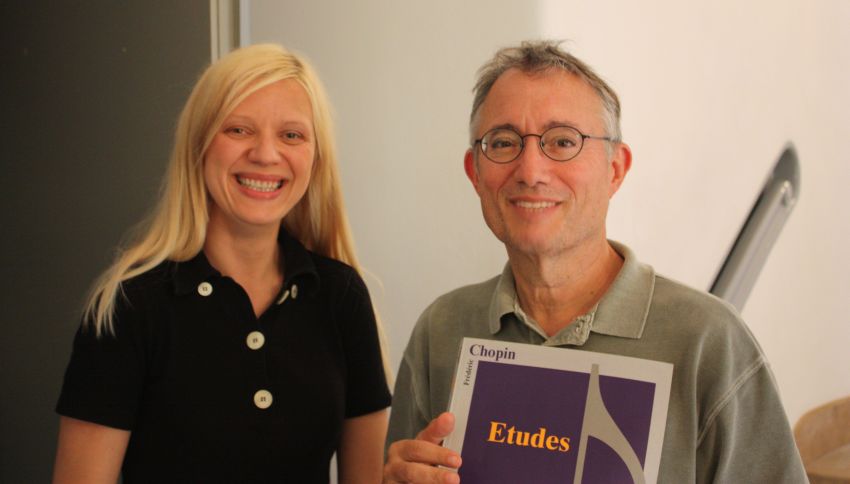
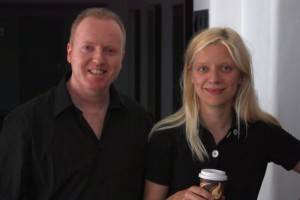
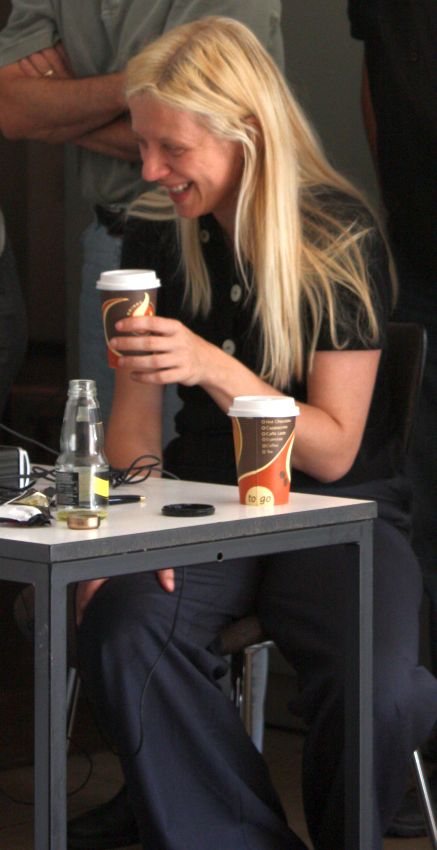
Me and Valentina during a coffee break
Valentina and the whole crew really loved the wonderful response from the livestream webcast’s visitors.
Right after finishing the recordings Valentina takes a look into the chatroom and starts chatting
As soon as Valentina had finished Op.25-12 she switched to another keyboard and entered the chatroom for a final talk with the viewers and ‘followers’. Big Fun for evryone ! 🙂